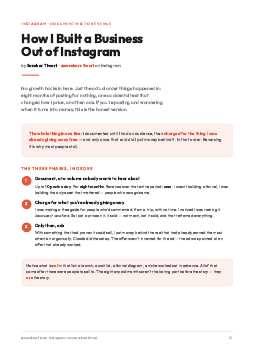
No growth hacks in here. Just the actual order things happened in: eight months of posting for nothing, one accidental test that changed how I price, and then ads. If you're posting and wondering when it turns into money, this is the honest version. The whole thing in one line: I documented until I had an audience, then charged for the thing I was already giving away free — and only once that sold did I put money behind it. In that order. Reversing it is why most people stall.
The three phases, in order 1
Document, at a volume nobody wants to hear about
Charge for what you're already giving away
Only then, ads
Up to 10 posts a day. For eight months. Revenue over that entire period: zero. I wasn't building a funnel, I was building the only asset that mattered — people who recognise me. I was making a free guide for people who'd commented, from a trip, with no time. I noticed I was rushing it because it was free. So I put a price on it. It sold — not much, but it sold, and that reframed everything. With something that had proven it could sell, I put money behind the reel that had already earned the most attention organically. Claude did the setup. The offer wasn't invented for the ad — the ad was pointed at an offer that already worked.
Notice what is not in that list: a launch, a waitlist, a funnel diagram, a niche worked out in advance. All of that came after there were people to sell to. The eight unpaid months aren't the boring part before the story — they are the story.
1 Eight months, zero rupees
The part people skip
I posted up to ten times a day for over eight months and made nothing from it. Not a small amount — nothing. If you're three weeks in and wondering why there's no money yet, that's not a signal. It's week three.
10 / day
8+ months
posts, at peak
before any revenue
earned in that window
2 How you post that much without dying
The mechanic
You cannot invent ten pieces of content a day. You can only record what you're already doing. I was building software anyway — so the work was the content, and the content cost me almost nothing extra. Film the work, don't script the content. A bug you fixed, a number you checked, a thing that broke. That's a post. You already did the hard part. One session, many cuts. A single recording of real work becomes several posts. This is where the volume actually comes from — not from having ten ideas. Post before it's good. The version you'd be slightly embarrassed by, published today, beats the polished one you never finish. Keep going through silence. Most of those months had no meaningful response. The compounding is invisible right up until it isn't.
3 What you're actually building
Why it's worth it
Not views. Recognition. The difference between a stranger seeing your offer and someone who has watched you work for months seeing it — that gap is the entire business. Everything in phase 2 and 3 only works because phase 1 happened first.
Phase 2 · the accident
— The realisation, on a trip
The turn
I was travelling, and I'd promised a guide to everyone who commented on a reel. I sat down to make it and caught myself rushing — cutting it short, keeping it thin. Not because I didn't care. Because it was free, and free work competes badly for your attention against everything else in your day. That was the whole insight: a price doesn't just capture value, it buys the maker's time. If someone paid for it, I could justify spending a full day making it properly — and they'd get something far better than the rushed free version.
— So I tested it
The result
I put a price on it and sold it to my own audience. It made a few sales. Small money — and it genuinely shocked me. I'd charged for software before, that felt normal. But someone paying for a PDF I wrote was a different thing entirely. It meant the audience wasn't only worth something when I shipped an app. The number didn't matter. The proof did. A few sales says the thing is sellable; the size of the number is a volume problem, and volume is solvable. Never ship an ad at something that hasn't cleared this bar first.
— Do this the same way
Your turn
Find the free thing you already give away. The guide, the template, the answer you keep typing into DMs. That's the product — you just haven't priced it. Price it low and ship it this week. The test is "will anyone pay", not "how much can I charge". That question comes later. Sell it to the audience you already have. No ads, no launch. If the people who watch you daily won't buy, strangers certainly won't. Then make it properly. Paid means you can afford the day it deserves. That's the deal you're making with the buyer.
— Why I even tried ads
The trigger
I'd been watching a company called 10x and how deliberately they bought attention, and I wanted to know whether the same thing worked at my size. I had something that had already sold on its own — that's the only reason the question was worth asking.
— What I actually promoted
The pick
Not a new creative. The reel that had already performed best organically. It had proven, for free, that it could stop people — so paying to show it to more people is the low-risk version of the bet. A brand-new ad asks you to gamble on the creative and the offer at the same time. Let organic pick your creative. Your best-performing reel is a tested ad you already own. Point it at the thing that already sold. Ads multiply an offer; they don't rescue one. Claude did the setup. Campaign structure, audiences, the pixel plumbing — the part that stops most people from ever running their first ad is configuration, not strategy, and that part is now answerable. Judge it on sales, not on the ad dashboard. Whether the money came back is the only metric that settles the argument.
— The order, one more time
If you take one thing
Audience → proof it sells → ads. Most people try to run it backwards: build the product, run ads at strangers, hope an audience appears. Each phase here pays for the next one, and skipping one just means the next won't work and you won't know why.
Want the ads part in full? Phase 3 is a whole playbook on its own — the exact Claude setup, campaign structure, and how I read whether it's working. That's Run Meta Ads With Claude, ₹399, at sanskartiwari.io/run-meta-ads-withclaude.